The Founder

As Featured In

Best Orthopaedic Surgeons in America

Global Healthcare Magazine — Feb 2026
In Practice
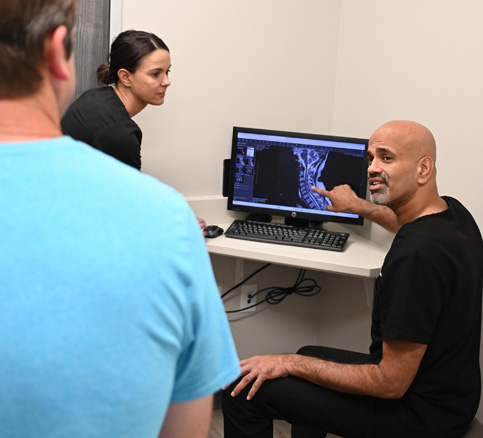
The question has never been "what is wrong with me?" The question is: what conditions is my body rebuilding under?
It was designed to diagnose disease and manage symptoms. It is extraordinarily good at that. But there is a gap so large it shapes the health trajectory of hundreds of millions of people: the system has no mechanism for detecting or addressing the slow erosion that precedes disease.
The space between optimal function and diagnosable disease is enormous. Most of the population lives in that space — functioning well enough to avoid a diagnosis, declining slowly enough to not trigger concern, normalizing the gradual loss of capacity because no one has given them a framework for recognizing it.
Most people experience their physical state as something that happened to them rather than something built by them. They notice stiffness, low energy, slower recovery — and blame age. But aging is time passing. Degeneration is what happens when the forces breaking your body down consistently outpace the forces building it back up. One is inevitable. The other is not.
Every system in nature has a way of accounting for itself. Your body is keeping score right now, whether you are aware of it or not. The Vital Order Index gives you a way to read that score.
Everything that helps your system build, repair, and restore. Sleep. Nutrition. Movement. Connection. Meaning. These are not lifestyle preferences. They are biological inputs.
Everything that overwhelms repair and degrades structure. Chronic stress. Sleep debt. Inflammation. Isolation. The cost accumulates silently until it becomes impossible to ignore.
How well your daily patterns work together. Same raw input, dramatically different output — based purely on timing, consistency, and whether your system receives clear signals.
Whether your system can absorb disruption and recover. A well-rested person has a wide adaptive window. An exhausted one has a narrow one. The same stressor builds one and breaks the other.
This is not philosophical. It is biological. Your nervous system is wired for co-regulation — the process by which proximity to safe, familiar people calms the stress response, stabilizes hormonal rhythms, and promotes repair. In the absence of co-regulation, the system runs hotter, stays more vigilant, and recovers more slowly. Indefinitely.
Patients with strong social support recover faster from surgery. They report less pain. They return to function sooner. The surgery is identical. The relational environment is different. And the body responds.
Before you build, reduce the load. Before you add, remove what is draining. Removing one significant chronic stressor frees more biological resource than adding five supplements combined.
The smallest sustainable change that compounds. A modest habit maintained every day for ninety days produces more structural change than an intense habit maintained for two weeks.
Your body responds to what you do repeatedly. Structure is history made visible. Your current state is a record of your past patterns — not a permanent sentence about your future ones.
A person trending upward is in a better position than a person with a higher score trending downward. The trend line tells you where you are going. That is the real measure.
You have been told there is nothing else that can be done. You suspected that was not the whole truth. Your body wants to heal. It needs the right conditions.
You became a healthcare professional because you wanted to heal people. The system channeled that impulse into a narrow set of activities that do not feel like healing. The impulse is still there.
You are young enough to still be deciding what kind of life you want to build. The decisions you make now are writing the future in real time. That is not a burden. It is leverage.
The equation does not care how old you are when you start. It cares about one thing: what are you doing now?